A lot of people have quietly stopped using a calorie app and started typing their lunch into ChatGPT instead. It's free, it understands a bowl of pho from the place near work
, and since January it even has a dedicated Health space that can connect to MyFitnessPal. So can it actually count your calories?
Roughly, when you describe the food in words; less reliably from a photo. In a JAMA Network Open study, GPT-4 and GPT-3.5's energy estimates weren't significantly different from nutritionists' across eight menus, though only about 35–48% of individual foods were within 10%. In a 2025 test using photos of boxed meals, five chatbots' calorie estimates ranged from 71% to 127% of the label. It's a decent estimator. It isn't a tracker: it doesn't keep your day, your week or your targets unless you build that yourself.
#What ChatGPT is genuinely good at
The thing a chatbot does well is the thing database apps do badly: it understands food the way you describe it. Half a chicken burrito bowl, no sour cream
, the leftover lasagne, a decent slab
, two of those protein balls from the café
. There's no search box, no list of 40 near-identical entries, no guessing which lasagne
is closest. (It's the same reason describing a meal beats typing it into a search.)
It's also good at the explaining: why a smoothie is higher in kilojoules than it looks, where the protein in a meal is coming from, what a lighter swap would be. And it converts units without fuss, which matters in Australia, where labels are in kilojoules and most apps think in calories. (More on that.)
#What the research says
Three studies are worth knowing. Two tested chatbots directly; the third tested the photo features of calorie apps, which run into the same problem.
| Study | What was tested | Input | Main finding |
|---|---|---|---|
| Hoang et al., JAMA Network Open, 2023 | ChatGPT-3.5 and GPT-4 | 222 individual foods, in English and Chinese | Energy within 10% of the reference for about 35–48% of foods; across eight menus, no significant difference from nutritionists for energy, carbs or fat; GPT-4 tended to overestimate protein |
| Hsuan et al., Nutrients, 2025 | GPT-4o, Gemini, Grok 3, Copilot and Claude 3.7, against four dietitians | Photos of eight boxed convenience-store meals | Calorie estimates ranged from 71% to 127% of the label depending on the chatbot; dietitians who weighed the meals averaged 99.5% |
| Charles et al., NUTRITION 2026 abstract | Photo features of four calorie apps | 102 weighed meals | All four came in low by 252–345 calories per meal, mostly fat |
Read together, a pattern shows up. Described in words, the estimates land close to nutritionists' on average, even though plenty of individual foods are off by more than 10%. From a photo, the errors get large, and they don't all go the same way. The studies differ in a lot of ways, so treat that as a pattern rather than a verdict.
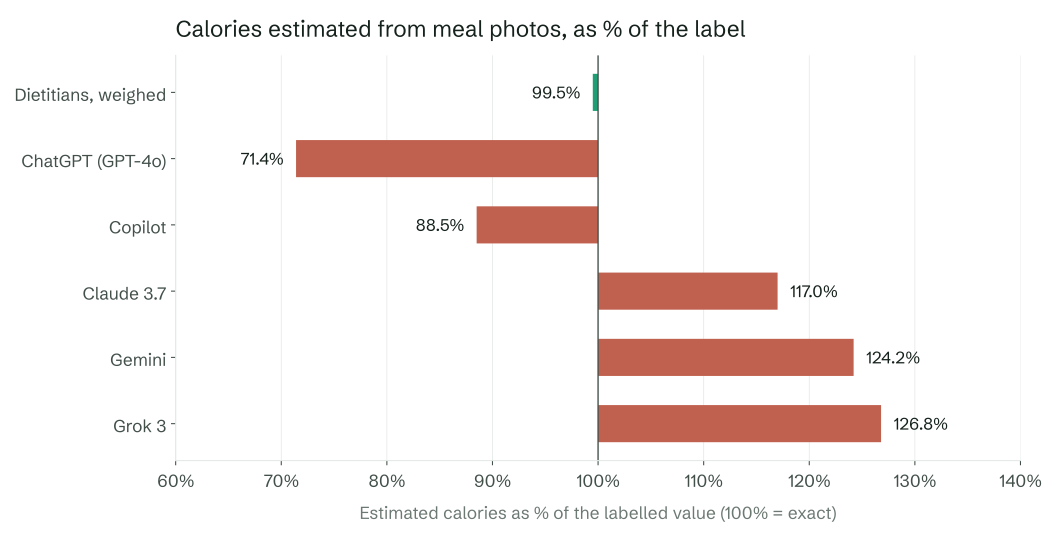
The meal-box study also asked each chatbot the same thing three times on one day, then again on three consecutive days, to see how much the answers moved. For calories, the variation ran from about 5% to 17% depending on the chatbot, with Claude and ChatGPT the steadiest. No chatbot consistently matched the dietitians. It was a small study, eight meals from one convenience-store chain in Taiwan, and its abstract and tables don't fully agree on which chatbot did best, so read the individual bars as indicative rather than as a ranking.
The third study isn't about chatbots, but it explains why photos are hard for any AI: the calorie apps it tested missed about 30 g of fat a meal, because oil and butter don't show up in a picture. (The full breakdown is here.)
#The real problem: a chat isn't a log
Estimating a meal is only half of tracking. The other half is the boring part: adding it up, every day, the same way, for weeks. That's where a general chatbot is weakest.
There's no running total by default. Each meal is a separate answer unless you keep everything in one long conversation and ask it to keep a tally, and a long tally is easy to let drift.
The same meal can get a different number on another day. In the meal-box study, repeat calorie answers moved by roughly 5–17% depending on the chatbot. That's noise on top of the estimation error, and for tracking a stable estimate matters more than a perfect one, because what you're really watching is the trend.
There are no targets or week view unless you build them. You can tell it your goal; it won't hold you to it across separate chats.
It doesn't notice patterns unless you ask. That lunches have crept up since the office move, or that weekends are where the week goes, only comes out if you think to ask the question.
None of that is a criticism of the model. It's a general assistant, and a food log is a narrow, repetitive job.
#What about ChatGPT Health?
OpenAI launched ChatGPT Health on 7 January 2026: a separate space for health conversations that can connect to services including Apple Health, MyFitnessPal and Weight Watchers, so answers can draw on data you've logged there.
That design says something. Even OpenAI's own health product leans on a dedicated tracker to do the tracking. ChatGPT becomes the conversation on top; the diary still lives in an app.
It launched as a gradual rollout, and some integrations, including medical records, are US-only. If you're in Australia, check what's actually available in your account before planning around it.
#How to get better estimates from ChatGPT
If you're going to use it, a few habits make a real difference:
1. Say how it was cooked. Fried in about a tablespoon of oil
or with a knob of butter
. Hidden fat was most of the error in the NIH test of photo apps, and it's the easiest thing to add in words.
2. Give amounts it can work with. Cups, grams, or hand sizes: a fist of rice
, a palm of chicken
. (Hand portions are surprisingly accurate.)
3. Ask for a range and its assumptions. The assumptions show you what it guessed, which is where you can correct it.
4. Ask for kilojoules. If you're reading Australian labels, it saves converting twice.
5. Use the label when there is one. For packaged food, the nutrition panel beats any estimate.
A prompt that works
I'm tracking food in Australia. Estimate kilojoules, calories and protein for: two eggs scrambled in a teaspoon of butter, one slice of sourdough, a flat white with full-cream milk. Give a low–high range, list your assumptions, and keep a running total for today.
#When a dedicated app is the better tool
If you like describing food in plain words, you don't have to give that up to get a proper log. Most trackers now accept a typed or spoken description: MyFitnessPal and Lose It on their paid tiers, Cronometer Gold, MacroFactor. What they add is the ledger: a running day, targets, history, a week you can look back on.
Rekkon is built around the same idea as the chat: you say what you ate, the way you'd say it to a person. The difference is what happens next. It keeps the running day in kilojoules or calories, every estimate is editable, and you can ask it what dinner should look like given what's already been logged. It notices patterns across weeks without being asked. It's iPhone only, and paid after a free trial.
Describe it like you'd tell ChatGPT. Rekkon keeps the tally.
Say what you ate in plain words. Rekkon estimates it, adds it to your day in kilojoules or calories, and coaches from what's actually been logged.
Try Rekkon free
#The honest bottom line
ChatGPT is a good estimator and a poor ledger. For a quick roughly how much is this?
it's genuinely useful, especially if you tell it how the food was cooked. For losing weight, the estimate was never the hard part. Doing it consistently for months is.
And whichever tool you use, a chatbot, a photo app or ours, the number is an estimate that usually runs low. Check it against your weight trend over a few weeks, not against the calorie.
#Common questions
Can ChatGPT count calories accurately?
Described in words, its estimates were close to nutritionists' on average: in a JAMA Network Open study, GPT-4 and GPT-3.5's energy estimates weren't significantly different from nutritionists' across eight menus, though only about 35–48% of individual foods were within 10%. From photos it's less reliable: in a 2025 study of boxed meals, five chatbots' calorie estimates ranged from 71% to 127% of the label. Treat it as an estimate, not a measurement.
Is ChatGPT better than a calorie counting app?
It's often better at understanding a described meal, because there's no database to search. It's worse at the tracking itself: unless you set it up, it doesn't keep a running daily total, targets or a week-by-week view, and the same meal can get a different estimate on another day.
Can ChatGPT estimate calories from a photo of food?
Yes, but photos are the weakest input. In a study of five chatbots, calorie estimates from meal photos ranged from 71% to 127% of the label, and in an NIH test of calorie apps' photo features most of the miss was fat, such as cooking oil, that a picture can't show. Describing the meal, including how it was cooked, gives it more to work with.
What is ChatGPT Health?
A dedicated health space OpenAI launched on 7 January 2026. It can connect to services including Apple Health, MyFitnessPal and Weight Watchers, so conversations can draw on data you've logged there. It rolled out gradually, and some integrations are US-only.
What's the best prompt for counting calories with ChatGPT?
Describe the food with amounts and cooking method, and ask for kilojoules and calories as a low–high range with its assumptions listed. For example: estimate kJ, calories and protein for two eggs scrambled in a teaspoon of butter on one slice of sourdough; give a range and list your assumptions.